
Library · Treatment
Proton Therapy and X-Ray Therapy
Proton Therapy and X-Ray Therapy: What's Actually Different?
Why this comes up
If you have been told you need radiation, you may have heard about two kinds: standard radiation, which uses X-rays (also called photons), and proton therapy, which uses particles from the center of an atom.
You may also have heard that protons are "newer," "safer," or "more precise." Some of that is true, some of it is more complicated, and some of it is still being studied. This guide walks through what is genuinely different, what we know, what we don't know yet, and why proton therapy isn't simply given to everyone.
Radiation works the same way in both cases: it damages the DNA inside cells. Cancer cells are generally worse than normal cells at repairing that damage, so with enough dose delivered over enough treatments, tumors die while most healthy tissue recovers. Protons and X-rays kill cancer by the same basic mechanism. The difference is not what they do to a cancer cell. The difference is where in your body the energy gets deposited along the way.
Part 1: How each beam gives up its energy
X-rays: they pass through
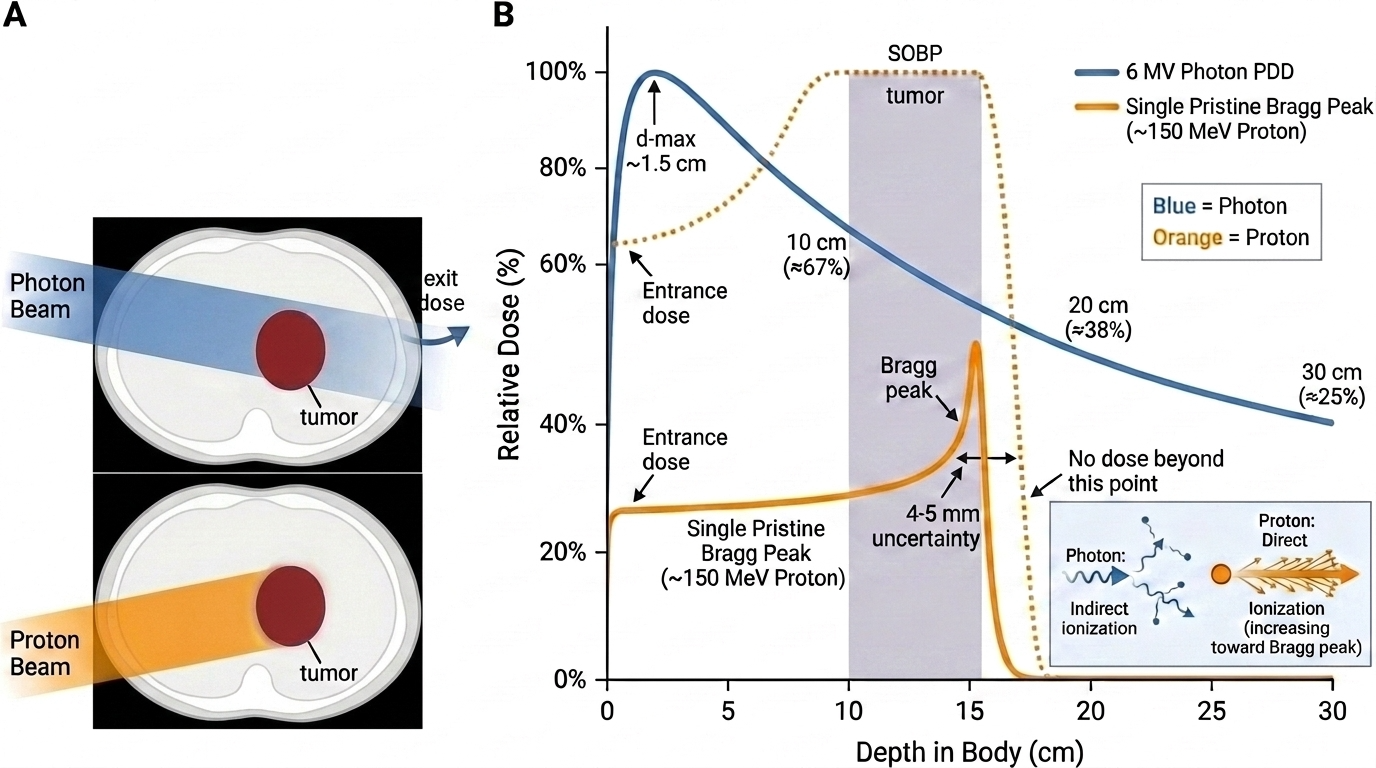
X-rays are pure energy with no weight and no electrical charge. Because they carry no charge, they don't rub against the tissue they pass through. They travel until they happen to collide with an electron in one of your cells. That collision is a matter of chance — it might happen at 1 centimeter deep, or 15 centimeters deep.
The practical result: an X-ray beam gets weaker the deeper it goes, but it never runs out. Some of the beam always makes it out the other side of your body. Radiation oncologists call this exit dose.
Because a single X-ray beam deposits dose all along its path, we use many beams from many angles. They all overlap at the tumor, which gets a large dose, while each individual path through healthy tissue gets a smaller share. This works very well — but the tissue in all of those paths still receives some radiation.
Protons: they stop
A proton is a particle with weight and a positive electrical charge. Because it is charged, it interacts with almost every atom it passes, constantly tugging on electrons and losing a little speed each time.
Here's the key fact: the slower a proton goes, the more energy it dumps per millimeter. So a proton drops relatively little energy while it's moving fast near the surface, then unloads a burst of energy right as it slows to a stop. Physicists call that burst the Bragg peak, after William Bragg, who described it in 1904. Past the stopping point, there is no exit dose.
We control where the proton stops by choosing how fast it starts. A higher-energy proton goes deeper. To cover a tumor from front to back, the machine stacks protons of many different energies so their stopping points fill the whole tumor.
The catch that comes with stopping
Stopping is the advantage, and it's also the challenge. With X-rays, being slightly off about tissue density mostly makes the dose a little higher or lower. With protons, being slightly off changes where the beam stops, which can greatly impact the dose.
Your team calculates that stopping point from your CT scan, but the calculation has some built-in uncertainty — typically a few percent of the depth, which can be a few millimeters. Real bodies also change during treatment: gas moves through the bowel, bladders fill and empty, tumors shrink, patients lose weight. Proton teams handle this with extra safety margins, repeat imaging, and planning methods designed to stay accurate even if things shift. It is manageable, and it is managed every day — but it is real work, and it is one reason protons are not automatically better in every situation.
Part 2: VMAT versus IMPT — the two most modern techniques commonly offered
Both proton and photon technologies have undergone technological refinements over the years. Comparing the old version of one to the new version of the other isn't a fair comparison, this compares the most modern versions of each.
VMAT (Volumetric Modulated Arc Therapy) — the X-ray version
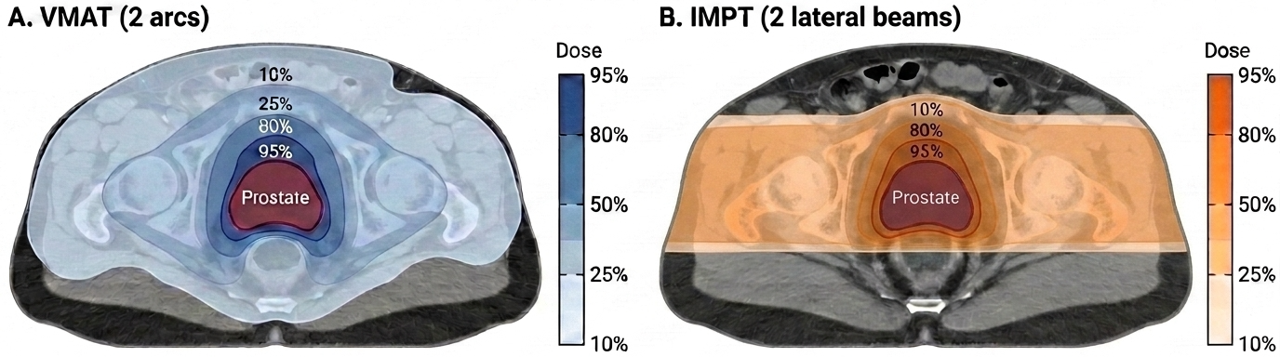
The treatment machine rotates around you, often making one to three full turns. While it turns, a set of motorized metal leaves inside the machine constantly reshapes the beam, and the machine speeds up, slows down, and changes intensity. The result is thousands of tiny beam shapes blended into one sculpted dose.
- Treatment usually takes about two to five minutes on the table.
- The high-dose region wraps tightly around the tumor.
- Because radiation comes from all around you, a fairly large volume of nearby tissue receives a small dose. Clinicians call this the low-dose bath.
- It is forgiving. Small day-to-day changes in your anatomy usually shift the dose only slightly.
IMPT (Intensity Modulated Proton Therapy) — the proton version
Instead of a broad beam, IMPT uses a narrow pencil of protons, about the width of a pencil eraser, steered by magnets. The machine paints the tumor spot by spot and layer by layer, adjusting the energy to move to a new depth each time. Most plans use two to four directions rather than a full rotation.
- Treatment time is broadly comparable, though setup and imaging can take longer.
- The high-dose region wraps around the tumor about as tightly as VMAT does.
- The total amount of radiation energy deposited in your whole body is typically roughly half that of an X-ray plan, and the low-dose bath is much smaller.
- It is less forgiving of anatomy changes, so it requires more careful planning and often more frequent imaging or re-planning.
The simple summary of the comparison
For most tumors, both techniques can deliver the prescribed dose to the tumor equally well. They differ in what happens outside the tumor.
Where the tissue you're trying to protect is pressed right up against the tumor, both plans give it a similar dose, because you cannot spare something the tumor is touching. Where the tissue you're trying to protect is farther away — spread across the chest, the pelvis, the neck, or the bone marrow — protons can genuinely spare it.
That distinction explains a lot of what clinical studies have found.
Part 3: What we hope protons do, and what the evidence actually shows
The reasoning behind proton therapy
Less radiation to healthy tissue should mean:
- Fewer side effects during and shortly after treatment
- Fewer long-term side effects years later
- Fewer new cancers caused by the radiation itself, decades later — most relevant for children and young adults
- Less damage to the bone marrow and immune system, which may matter more now that many patients also receive immunotherapy
This reasoning is sound, but "should" is not "does." Medicine is full of ideas that made perfect sense and turned out not to help patients. So researchers have run head-to-head trials in which patients agree to be assigned to protons or X-rays at random. That design is the fairest way to compare two treatments, and it is the standard we hold new treatments to.
Here is where those trials stand.
Prostate cancer: no measurable difference
The PARTIQoL trial randomly assigned 450 men with low- or intermediate-risk prostate cancer to proton therapy or X-ray therapy. Results were first presented in 2024.
Finding: no significant difference between the two groups — not in bowel function, not in urinary symptoms, not in sexual function, and not in cancer control.
This is an important, credible negative result. Both treatments worked well and caused few serious problems. For most men with localized prostate cancer, there is currently no evidence that proton therapy produces a better outcome than modern X-ray treatment.
Trial record: ClinicalTrials.gov NCT01617161. Trial design and enrolled patients, on PubMed: PMID 39357788 (DOI). The main results were presented at the 2024 ASTRO meeting; the full journal report is still in press.
Breast cancer: quality of life the same so far; the main question is still open
The RadComp trial randomly assigned 1,239 patients with breast cancer needing comprehensive lymph node radiation. It is the largest head-to-head proton-versus-X-ray trial ever run.
Finding so far: quality of life at six months was excellent and essentially the same in both groups. Proton-treated patients were more likely to say they'd choose their treatment again — but patients knew which treatment they received, which can influence that kind of answer.
RadComp was designed to answer a longer-term question: does proton therapy reduce heart problems years later? Proton plans clearly delivered less radiation to the heart. Whether that translates into fewer heart attacks and heart failure is not expected to be known until sometime between 2028 and 2032.
Trial record: ClinicalTrials.gov NCT02603341. Trial design, on PubMed: PMID 31619413 (DOI). Quality-of-life results were presented at the 2025 ASTRO meeting; the full journal report is still in press.
Throat cancer: two large trials, two different answers
This is the most instructive part of the story, emblematic of the challenges comparing the approaches: two well-run randomized trials asked nearly the same question about the same cancer and did not reach the same conclusion.
The US trial (published in The Lancet, December 2025). 440 patients with advanced oropharyngeal cancer — cancer of the tonsil or base of tongue — were assigned to IMPT or IMRT, both with chemotherapy, at 21 US centers between 2013 and 2022. Cancer control was equivalent. Patients treated with protons had less severe difficulty swallowing (31% vs 49%), were less likely to need a feeding tube (27% vs 40%), and had less severe damage to their immune cells (76% vs 89%). Five-year survival was 91% with protons versus 81% with X-rays.
Read the study on PubMed: PMID 41391462 (DOI).
The UK trial, TORPEdO (published in The Lancet, March 2026). 205 patients with the same cancer were assigned to IMPT or IMRT at 20 NHS hospitals between 2020 and 2023, using the same radiation dose and the same chemotherapy. This trial had two main questions, and protons did not improve either one. At 12 months, feeding-tube dependence was 2% in both groups. Severe weight loss was actually more common in the proton group (18% vs 6%). Patient-reported physical quality of life was the same (78.3 vs 77.1). Swallowing scores were the same (79.4 vs 79.5). At two years, cancer control and survival were the same, about 95% in both groups.
Protons did reduce some short-term side effects. Severe mouth sores and swallowing trouble during treatment were less common with protons. But those differences had largely disappeared within about six weeks after treatment ended, and by twelve months the two groups looked alike. The UK investigators concluded that where proton therapy is not already routine, modern IMRT remains the standard of care.
Read the study on PubMed: PMID 41875914 (DOI).
How can two trials disagree? Several reasons, and none of them means either trial was done badly.
- The US trial enrolled patients over nine years, during which both proton and X-ray technique improved substantially. The UK trial ran over three years with uniformly modern technique on both sides.
- In the US trial, a substantial number of patients did not end up receiving the treatment they were assigned. That complicates interpretation.
- Survival was not the US trial's main question, and its survival result was statistically borderline. More patients in the X-ray group died after their cancer came back, and more died of treatment complications — both of which can shift a survival curve for reasons that are hard to attribute cleanly to the beam.
- The UK trial was smaller, followed patients for a shorter time, and had very few deaths in either group, so it had limited ability to detect a survival difference even if one exists.
Other researchers have published formal criticism of the US survival finding in the same journal, and the US investigators have replied. This is normal, healthy scientific argument, and it is not settled. What we can say fairly today: in throat cancer, proton therapy reliably reduces certain side effects during and shortly after treatment; whether it improves long-term function or survival remains genuinely uncertain.
Lung cancer: answer still pending
A large national trial (NRG/RTOG 1308) comparing protons to X-rays for lung cancer finished enrolling patients in 2023. Survival results have not yet been reported.
Trial record: ClinicalTrials.gov NCT01993810.
Children, and a few rare tumors: strong rationale, no randomized trials
For children, tumors at the base of the skull, eye tumors, and for patients who need radiation to an area treated before, proton therapy is widely used and often considered the preferred option. This is based on the physics, decades of follow-up, and on the fact that a child's growing tissue is far more vulnerable to stray radiation.
The bottom line on evidence
Proton therapy's physical advantage is not in dispute. It is measurable on every treatment plan.
Whether that physical advantage turns into a better life for the patient is a separate question, and the answer depends on the specific cancer, the specific patient, and which healthy tissue is at risk.
Where the tissue we're protecting sits right against the tumor — the rectum in prostate cancer, for example — protons have not shown an advantage, and the randomized evidence there is clear. Where the tissue sits farther away and matters a great deal — bone marrow, the heart, a child's developing brain — the physical case is strongest, but for most of those situations we are still waiting on the outcome data. And in throat cancer, where we have two large randomized trials, they disagree with each other.
Part 4: So why not just treat everyone with protons?
The short answer is that proton therapy is expensive and scarce, and there is not enough of it to go around.
The machines are enormous
An X-ray treatment machine is roughly the size of a large refrigerator and sits in a shielded room. A proton system needs a particle accelerator that pushes protons to more than half the speed of light, plus a delivery arm that can weigh over a hundred tons, plus concrete walls several feet thick.
A conventional X-ray treatment room costs a few million dollars to build and equip. A single-room proton center generally runs $30–50 million. Larger multi-room centers have historically cost $100–200 million or more. Running one also costs more each year: more physicists, more engineers, more maintenance, more quality-assurance testing.
There are far fewer of them
Given the substantial infrastructure cost, there are roughly 50 proton centers in the entire United States, compared with thousands of X-ray radiation facilities. Proton therapy accounts for well under 1% of radiation treatments given in this country.
For patients, this means real-world barriers: driving or flying to another city, arranging lodging for six or seven weeks, taking time away from work and family, and often a lengthy insurance approval process.
Looking ahead
This field is moving quickly, and the direction is encouraging.
Proton accelerators are getting smaller and less expensive, which is already putting centers in cities that could never have supported one a decade ago. New imaging methods are shrinking the uncertainty about exactly where a proton stops, which means smaller safety margins and better sparing. Researchers are developing proton arc therapy, which rotates the beam the way VMAT does and may improve proton plans further. Others are studying FLASH radiation, delivered in a fraction of a second, which in laboratory work appears to spare healthy tissue in ways nobody fully understands yet. And better mathematical models are helping teams predict, before treatment starts, which individual patients stand to gain the most.
Meanwhile, the trials keep reading out. Lung cancer results are pending. Breast cancer heart outcomes are coming. Clinical trials in sites stretching from liver cancer to lymphoma to cervical cancer are enrolling.
Watch: Proton vs. Photon Therapy for Prostate Cancer
Dr. Nicholas Zaorsky discusses proton vs. photon radiotherapy for prostate cancer.
This document is for general education. It is not medical advice, and it cannot account for the details of your diagnosis. Please talk with your radiation oncologist about which approach is right for you.
Explore more topics
Browse the rest of the patient education library, or reach out with a question.