
Library · Treatment
The Radiation Therapy Process
Developing a high quality radiation treatment plan takes several days. This is a new and unfamiliar journey for many patients.
What is the process of developing a radiation treatment plan?
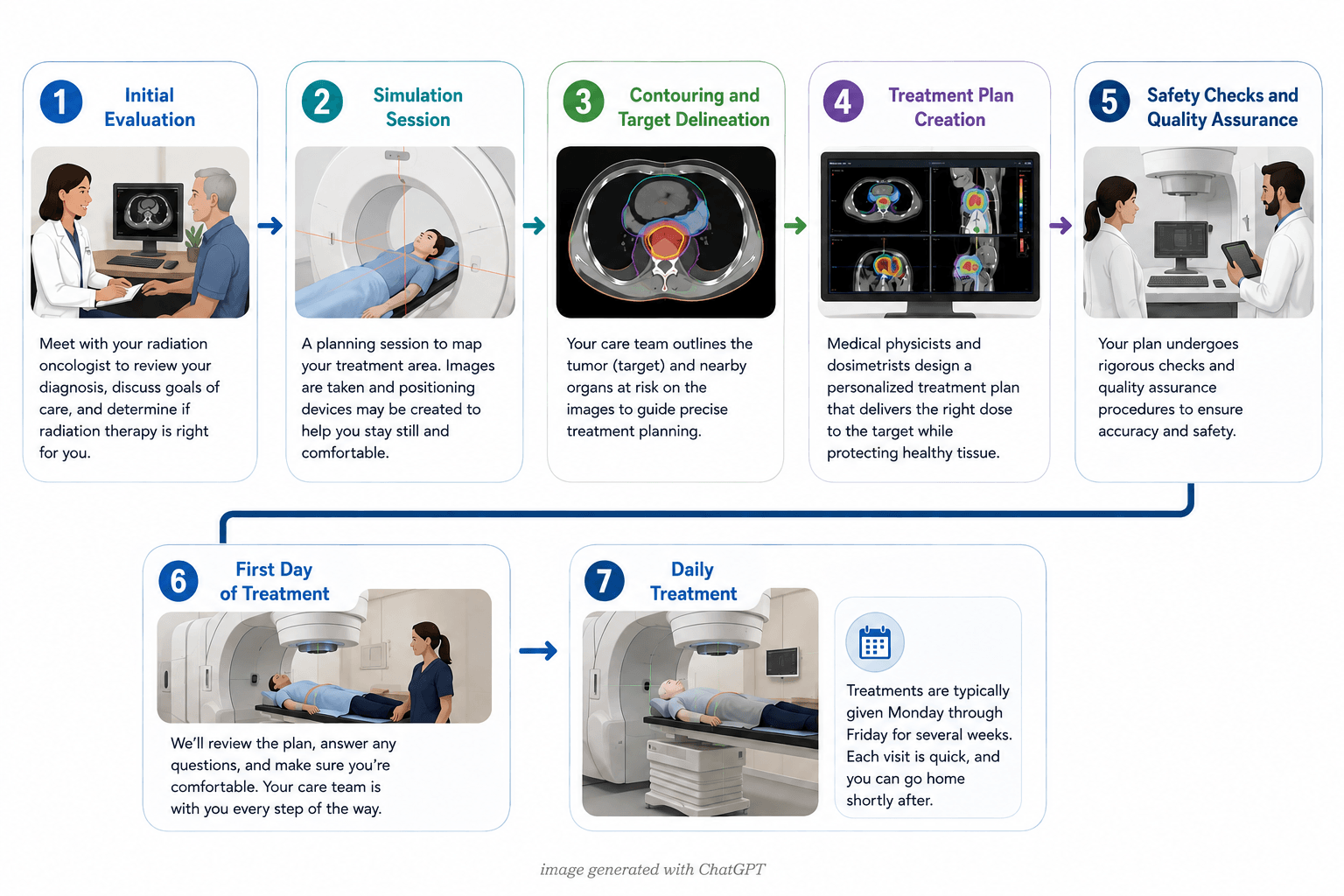
First you will meet with a physician who reviews your case and explains the plan. In the next few days you'll return for a planning session (called a "simulation" or "CT sim") where a CT scan is taken and small marks and custom devices are made so every treatment aims at the exact same spot. A nurse will meet with you to answer questions and provide additional education before you go home. This session is approximately an hour long.
Over the next several days the physician will outline the tumor (target volumes) and nearby organs at risk (OARs) on the images to guide precise treatment planning. This is often informed by other diagnostic imaging (MRIs, PET scans), pathology reports, and the physical exam. The goal is to maximize radiation damage to the cancer cells while minimizing damage to nearby healthy tissue.
Dosimetrists and medical physicists then utilize advanced software to translate the physician's intent into a treatment plan. This is an iterative process, taking several days to achieve various defined objectives. This often involves a 360 degree arc around the patient, with each degree comprising a radiation 'beamlet' of a unique shape and intensity. These 360 beamlets together become the comprehensive treatment plan. In some cases multiple arcs are used, escalating up to 720, 1080, or more beamlets. With such complicated plans, a rigorous series of checks and quality assurances is performed to ensure the accuracy and safety of your plan so treatment can commence uninterrupted.
This entire process takes several days to several weeks, depending on the level of complexity.
Who are the people involved in my care?
- Radiation Oncologist: your main doctor, the physician who performs the initial evaluation and decides the dose, oversees the plan, and checks on you throughout treatment
- Nurses: available every day, even if the physician is not present. They triage acute issues, coordinate care, and will often provide education and support
- Dosimetrists: healthcare professionals who design and optimize the radiation plans, in collaboration with physicians and medical physicists
- Medical Physicists: healthcare professionals who calibrate and double-check the radiation plans and delivery machines to ensure accuracy and safety
- Radiation Therapists: trained professionals who position you and operate the advanced machinery each day
What do I expect on days of treatment?
You'll check in at the front desk to notify the treatment machine you're present. If needed, you'll change into a gown and wait in smaller room close to the machine. The therapists will prepare the table with your personal devices as needed and will assist you in getting on the treatment table. Lasers in the room are used to align marks placed on your body at the simulation. The therapists will then step out of the room. Often, the machine will obtain imaging (an x-ray or CT scan) to look inside the body to fine-tune alignment (Image-Guided Radiation Therapy). You may feel the table shift slightly as the therapists make micro-adjustments. Once they are satisfied with this, treatment will commence and the machine will rotate around you. Expect some noise, but you won't feel the radiation itself. These are high-energy X-rays that go through you, much like a CT-scan. You won't be radioactive. The radiation beam is often on for only a few minutes. When it's finished, you can get dressed and go about the rest of your day.
Explore more topics
Browse the rest of the patient education library, or reach out with a question.