
Library · General Information
What Are The Different Kinds of Radiation?
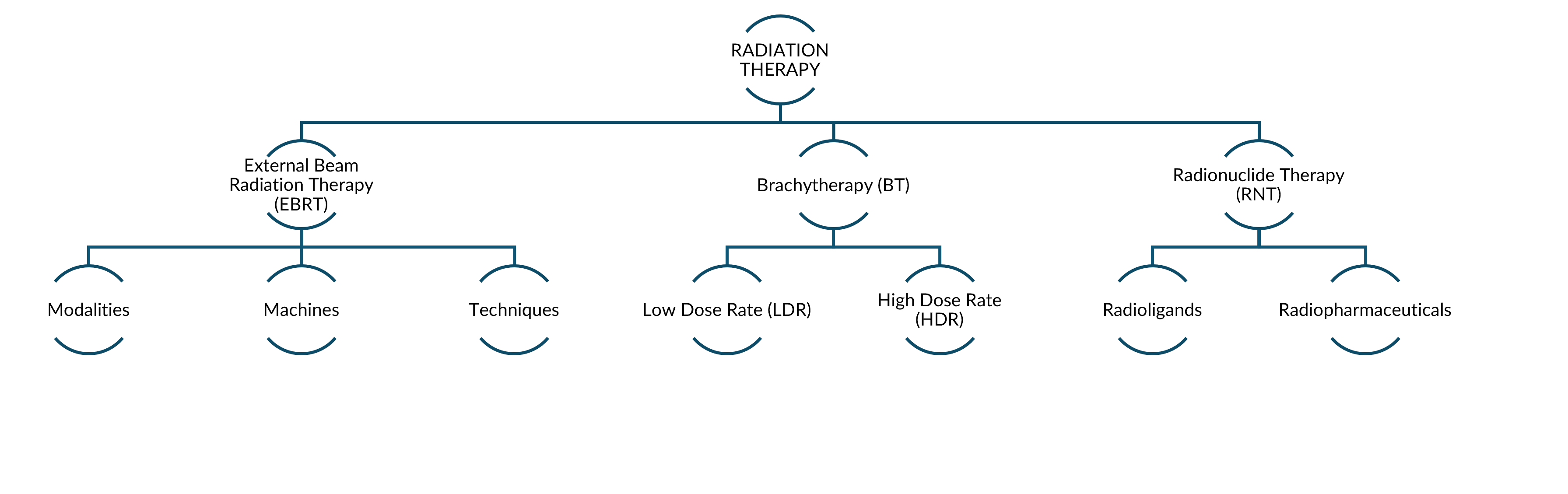
The highly technical terminology can be confusing even for other oncologists. Broadly, radiation therapy can fall into three classifications:
- External Beam Radiotherapy (EBRT) where the radiation is directed from a machine outside the body at a tumor
- Brachytherapy (BT) where a radioactive source is placed directly in the tumor
- Radionuclide Therapy (RNT) where a radioactive particle is absorbed into the body (by mouth or injection) and travels through the blood to cancer cells
External Beam Radiotherapy
This is the most common delivery method for radiation therapy. It is non-invasive where a machine outside the body aims high-energy rays or particles at the tumor. There are different modalities, different machines, and different techniques that are combined to damage the tumor while sparing nearby tissues.
Modalities
Common modalities you may hear of are electrons, protons, and photons. Think of these as three different types of radiation "beams". Each interacts with the body in different ways.
- Photons are the most common. They are high-energy X-rays that travel through the body, depositing energy along the way and continuing a bit past the tumor. They work well for tumors deep inside and are used for the majority of radiation treatments
- Protons are tiny charged particles. Unlike photons, protons travel to a set depth and then stop, releasing most of their energy at the tumor, with less radiation to the tissue beyond the tumor. This is available at specialized centers and is chosen for certain cases (especially in children), as we generate more data to investigate whether there are clinical advantages in the broader population
- Electrons are also charged particles, but they only travel a short distance into the body. They are useful for cancer on or near the skin surface because they don't go deep
Machines
There are a multitude of machines with various branding to denote slight differences in abilities. With the exception of the GammaKnife, all are linear accelerators (linacs for short), machines that use electricity to speed up charged subatomic particles along a path and generate ionizing radiation. These machines rotate around the patient as radiation is delivered, allowing the radiation beam to approach the tumor from different angles. Some linacs have specialized diagnostic imaging equipment attached to them (PET, MRI) for real-time imaging of tumors. Most linacs have the ability to obtain a real-time CT scan.
- C-arm Linac: the most common, featuring an open cantilevered arm that provides greater mechanical flexibility. Notable brands include the Varian TrueBeam and Elekta Versa
- Ring Linac: more compact, housing the equipment inside a closed ring, resembling a CT-scanner. Varian Halcyon and Accuray Radixact/TomoTherapy
- CyberKnife: mounts a linear accelerator on a 6-axis robotic arm, moving freely in multiple directions to target lesions from thousands of angles. This is in contrast to C-arm and Ring linacs that rotate in a single plane at a time
- GammaKnife: unique platform that uses fixed cobalt-60 radioactive sources (not a linac) in a 'helmet' to specifically treat lesions in the head
Techniques
These describe how the radiation is shaped, aimed, and delivered. As mentioned above, most linacs have the ability to generate imaging of the tumor in real-time with the patient on the table, whether that is CT, MRI, or PET imaging. When obtaining imaging prior to treatment and using it to fine-tune aiming of the radiation beam, this is called Image Guided Radiation Therapy (IGRT).
3-D Conformal Radiation Therapy (3DCRT) uses static beams of uniform intensity, conformed to the target shape. It is less precise but can be faster and simpler to generate a plan. Intensity Modulated Radiation Therapy (IMRT) breaks the radiation beam into beamlets and changes the intensity of the beam during the treatment. Volumetric Modulated Arc Therapy (VMAT) is an advanced form of IMRT, dynamically changing the beam shape and intensity as the machine rotates around the patient in a continuous arc. It is substantially more complex but offers the most tissue sparing with shortest treatment times.
Ablative radiation dosing delivers very high doses of radiation in just a few sessions with extreme precision. It is used for small, well-defined tumors in the body. For lesions in the head this is termed Stereotactic Radiosurgery (SRS) or Radiotherapy (SRT). For lesions in the body this is termed Stereotactic Body Radiotherapy (SBRT) or Stereotactic Ablative Radiotherapy (SAbR).
Brachytherapy
This is a specialized form of radiotherapy that involves placing radioactive sources directly in the tumor. The word "brachy" means "short", indicating the radiation travels just a short distance — giving a high dose to the cancer while limiting exposure to nearby tissues. This is most commonly used in gynecologic (cervical, uterine) and prostate cancers, though there are growing applications for brain tumors. Compared to EBRT, BT is invasive: trained surgeons must place the radioactive source itself or 'applicators' (tools for delivering the radioactive source) into the tissue of interest, often in the operating room and under anesthesia. Historically these are called "sealed sources" as the radioactive material is sealed inside a metal capsule.
Radioactive sources can be defined by how much radiation they deliver in a given period of time. Some deliver radiation slowly (Low Dose Rate, LDR) and are often permanent implants while others deliver radiation rapidly (High Dose Rate, HDR) and are often temporary implants. In the former patients are radioactive for a period of time while in the latter the radioactive source is removed at the end of the procedure and patients are not radioactive when they go home.
Radionuclide Therapy
Historically called "unsealed sources" as the radionuclide is freely able to traverse the body, this involves introduction of a radioactive isotope into the body (commonly through ingestion or injection) where the agent goes through the blood and localizes to specific cells depending on their properties. Radiopharmaceuticals refer any radioactive isotopes introduced to the body as a drug. Radioligands are a specific subtype where the radioactive isotope is attached to a molecule that helps it specifically target tumor cells. This latter category is a rapidly expanding area of research.
Explore more topics
Browse the rest of the patient education library, or reach out with a question.