
What is brachytherapy for prostate cancer?
Brachytherapy is radiation treatment given from inside the prostate instead of aimed at it from outside the body. Brachy comes from the Greek word for short. The radiation travels only a few millimeters, so the prostate receives a very high dose while the bladder and rectum next to it receive much less. Brachytherapy can be used by itself, or as a "boost" together with external beam radiation (and sometimes hormone therapy) for cancers with a higher chance of spreading. This page answers the questions patients ask us most. Your own care team will tailor these answers to you.
How does prostate brachytherapy work?
Short answer: A radiation source is placed directly in the prostate through thin tubes or needles. Radiation damages the DNA of cancer cells so they cannot divide, and they die off over the following months. There are two types: a temporary source (HDR) and permanent seeds (LDR).
| Feature | Temporary Implant (HDR) | Seed Implant (LDR) |
|---|---|---|
| What is placed | Thin hollow tubes (catheters). One tiny radioactive source passes through them. | Tiny metal seeds, each about the size of a grain of rice. |
| How long it stays | Minutes. The source and tubes are removed before you go home. | Permanently. The seeds give off radiation slowly over several months, then become inactive. |
| Number of treatments | Usually two. | Usually one. |
| Radioactive afterward? | No. | Slightly, for a short time. |
HDR means "high dose rate" and LDR means "low dose rate." Both are proven treatments. This page describes the HDR procedure in detail, because that is the treatment we use.
Is brachytherapy a good fit for me?
It works best for cancer that is still inside or right next to the prostate. It may be less suitable if you have:
- A very large prostate. Larger glands are more difficult to implant and can have greater side effects.
- Significant urinary problems before treatment, such as a very weak stream.
- A prior TURP (a "roto-rooter" procedure that removed part of the prostate).
- A health problem that makes anesthesia unsafe.
What happens during my HDR procedure?
Short answer: HDR brachytherapy is an invasive procedure under anesthesia. Thin catheters are placed through the skin behind the scrotum using ultrasound, a plan is built around them, and a machine delivers the radiation in about 10 to 30 minutes. Then everything is removed. Plan on spending most of the day with us. There is no cut or incision.
Before your procedure day
- Pre-procedure visit: We review your health, may order blood tests or a heart tracing (ECG), and you meet the anesthesia team. Many times this is done virtually.
- Medications: We will tell you whether to pause blood thinners, aspirin, or certain supplements, and for how long. Do not stop any medication on your own.
- Bowel preparation: You will usually use an enema the evening before or the morning of treatment, so the rectum is empty for clear ultrasound pictures.
- Fasting: No food after midnight. We will tell you which morning medications to take with a sip of water.
- A ride home: Arrange for an adult to drive you. You cannot drive for several hours after anesthesia.
On the day, step by step
- Check-in and anesthesia: A nurse starts an IV and you receive antibiotics to lower infection risk. You are given general anesthesia (fully asleep) or spinal anesthesia (numb from the waist down, usually with sedation). You will not feel the procedure.
- Positioning and urinary catheter: You lie on your back with your legs raised in padded supports. A soft urinary catheter (Foley) is placed into the bladder. It drains urine and lets us see the urethra on ultrasound, so we can protect it. Your scrotum and penis will be secured away from the perineum (the skin between the scrotum and anus), taped to your abdomen.
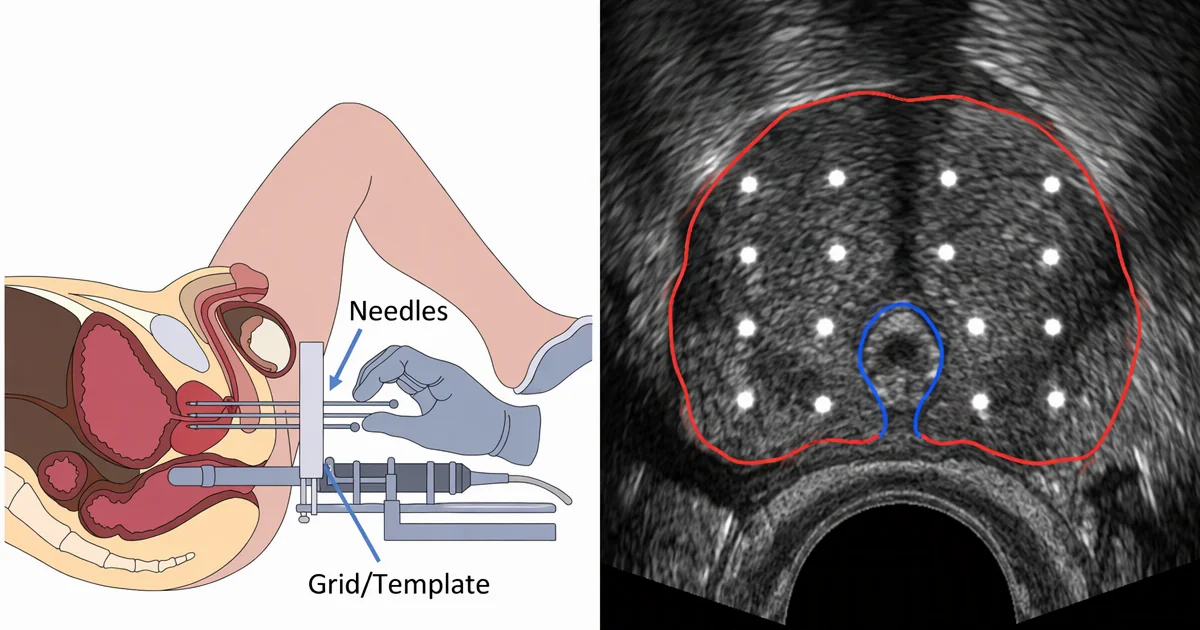
- Ultrasound of the prostate: A slim ultrasound probe is placed in the rectum. It shows the prostate, urethra, bladder and rectum on a screen in real time.
- Placing the catheters: A small plastic grid (template) rests against the perineum. Through it, your doctor guides about 12 to 20 thin hollow needles or plastic catheters into the prostate, spaced evenly so the radiation can reach every part of the gland. This takes about 60 minutes.
- Anesthesia recovery: You will be moved to a hospital stretcher and awakened from anesthesia. The remainder of your day will be spent in this bed, transported for each step as needed. The Foley catheter will remain in place to minimize need for any movement of the legs and hips.
- Imaging and building your plan: Pictures are taken with the catheters in place, using CT or MRI depending on the center. Your doctor outlines the prostate and the nearby organs to protect: the urethra, bladder and rectum. A medical physicist then calculates exactly where the radiation source should stop inside each catheter and for how many seconds. A second team member checks the plan independently before it is approved. The Foley catheter is typically removed before treatment.
- The treatment itself: Each catheter is connected by a thin tube to the treatment machine (an "afterloader"). This is a shielded machine that stores the radioactive source, a pellet of iridium smaller than a grain of rice attached to a thin wire. The staff step out of the room and watch you on camera the whole time. The machine sends the source into each catheter in turn, pausing at the planned spots, then pulls it back into its shielded safe. This usually takes 10 to 30 minutes. You will not feel it.
- Removing the catheters: Before anyone re-enters, a radiation meter confirms the source is back in the machine. The treatment catheters are then removed, and gentle pressure is held on the skin to stop any bleeding. Nothing radioactive remains in your body.
- Recovery and going home: With the catheters out, you're able to sit up, move, and recover a bit more. We check that you can urinate before you leave. Most men go home the same day. If you cannot urinate yet, you may go home with a catheter for a few days.
If you have more than one treatment
When HDR is used by itself, it is usually given as two treatments about 2 to 4 weeks apart, because a randomized trial showed two treatments controlled cancer better than one. Each treatment day repeats the steps above. When HDR is a boost with external beam radiation, it is often a single treatment given before the external beam course. In specialized situations, some centers give two treatments on consecutive days with the catheters left in place overnight in the hospital.
The first few days at home
- Expect soreness between the legs and pink urine for a few days. Over-the-counter pain relievers (ibuprofen, acetaminophen, phenazopyridine) are usually enough.
- Return to light activity in 1 to 2 days. Avoid heavy lifting, bike riding and hard exercise for about a week.
- Drink plenty of fluids, and take any urinary medicine we prescribe.
What are the side effects of brachytherapy?
Short answer: Urinary symptoms are the most common. They are usually temporary and are treated with medication. Bowel symptoms are usually mild.
Urinary symptoms (most men)
Radiation irritates the urethra, the tube that carries urine through the prostate. You may notice:
- Needing to urinate often or urgently
- Burning when you urinate
- A weaker or slower stream
- Getting up at night to urinate
After HDR, these usually begin within days and settle over several weeks. After seed implants they tend to last longer, and in one large series urinary symptom scores returned to baseline about a year after treatment on average. In a randomized HDR trial, most urinary quality-of-life scores returned to baseline after the first year in men treated with two HDR treatments. Medications that relax the prostate (such as tamsulosin and tadalafil) help most men.
A few men in 100 temporarily cannot urinate because of swelling. In large studies this happened in about 2 to 3 in 100 men, and nearly all recovered. It is treated with a catheter, usually for days to weeks. A larger prostate and more urinary symptoms before treatment raise the risk.
Other short-term effects
- Soreness or bruising between the legs for a few days
- Pink or red urine for a few days
- Blood in the semen, which can look dark or rust-colored for weeks
- Looser or more frequent stools, or a feeling of rectal irritation
- Mild tiredness
Will brachytherapy affect my continence?
Short answer: For most men, no. Lasting leakage after brachytherapy is uncommon.
In the first months, urgency can be strong enough to cause an occasional accident if you cannot reach a bathroom in time. This usually improves as the irritation settles. Total, lasting incontinence after radiation for prostate cancer is rare. The risk is higher if you:
- Have had a TURP or another procedure that removed prostate tissue. Older studies found high leakage rates. With modern planning, one prospective study found about 2 to 4 in 100 men with a prior TURP had leakage after seed brachytherapy.
- Already have significant urinary problems before treatment.
- Need a TURP after brachytherapy for a blockage.
Will brachytherapy affect my erections or sex life?
Short answer: Most men keep their erections at first. Erections may slowly weaken over the following years, and semen volume usually decreases. Many effective treatments exist.
Erections
Radiation affects the nerves, small blood vessels and erectile tissue near the prostate slowly, so changes tend to appear over 1 to 3 years or more rather than right away. Reported rates vary widely between studies. The best predictor of keeping erections is how good they were before treatment. Age, diabetes, heart disease and smoking also matter. In the HDR trial described above, men reported lower sexual function scores than before treatment at every follow-up visit.
If you also receive hormone therapy, expect lower sex drive and weaker erections while you take it. Hormone therapy is linked with worse sexual and other quality-of-life outcomes after radiation. These effects usually improve after it stops, though recovery can take months. Pills such as sildenafil (Viagra) and tadalafil (Cialis) work well for many men after radiation. Other options include injections and vacuum devices. Some urologists recommend starting early to protect erectile tissue. Please bring this up with us. It is a normal part of follow-up.
Ejaculation and orgasm
- Semen volume usually decreases, and some men eventually have little or no fluid. You can still have an orgasm.
- Ejaculation may be uncomfortable for the first weeks.
- Blood in the semen is common early and is not dangerous.
Your partner and fertility
Sex is safe for your partner. Radiation is not passed on through sex. After HDR you need no special precautions beyond waiting until the soreness settles. After a seed implant, use a condom for the first several ejaculations, because rarely a seed can come out in semen. Brachytherapy usually reduces fertility. If you may want children, ask about banking sperm before treatment.
What are the long-term risks unique to brachytherapy?
Short answer: Serious long-term problems are uncommon. The ones specific to brachytherapy involve the urethra, the rectum and, for seed implants, the seeds themselves. Telling your future doctors about your treatment prevents most avoidable problems.
- Urethral stricture: Scar tissue can narrow the urethra, causing a weak stream months to years later. In one series this happened in about 5 in 100 men within 5 years, and nearly all were treated with a minor procedure. The risk is higher when brachytherapy is combined with external beam radiation, and strictures after radiation tend to appear later than after surgery.
- Late rectal bleeding: Fragile blood vessels in the rectal lining can cause occasional bleeding, usually mild and often years later. Very rarely, an abnormal opening called a fistula forms between the rectum and urethra. In one center's 1,455 patients this happened in about 2 in 1,000.
- Procedures in the treated area: Radiated tissue heals more slowly. Fistulas have been linked to biopsies of the rectum after brachytherapy. Before a colonoscopy or any urology procedure, tell the doctor you had prostate brachytherapy and ask them to talk with your radiation oncologist before biopsying the front wall of the rectum. This risk decreases with time. We typically recommend avoiding any biopsies for 12 to 24 months after radiotherapy.
- Seed movement (seed implants only): A loose seed can travel through a vein to the lungs. This almost never causes symptoms or harm. In one large study, seeds moved to the chest in 46 in 100 men who had loose seeds, but under 1 in 100 when the seeds were linked together. HDR leaves nothing behind, so this does not apply.
- Second cancers: Radiation for prostate cancer is linked with a small increase in later bladder and rectal cancers, but absolute rates are low. In a large review, the increase was seen consistently with external beam radiation but not with brachytherapy.
Am I radioactive after brachytherapy?
Short answer: After HDR, no. The radiation source never stays in your body, and a meter confirms it is back in the machine before the catheters come out. You can hug your family, hold children and be around pregnant women right away.
With HDR, the source is in your body only during the minutes of treatment. Once it returns to the machine, no radiation remains. Your urine, stool, sweat and semen are not radioactive, and no precautions are needed at home or at work.
If you have seed implants instead
Seeds give off low-energy radiation that is almost all absorbed inside the prostate, and it fades over weeks to months. For the first one to two months, depending on the seed type, you will usually be asked to:
- Avoid long, close contact with pregnant women and young children, such as a child sitting on your lap. Hugs and normal time together are fine.
- Pick up any seed that comes out in your urine with a spoon or tweezers, not your fingers, put it in a small container and call your care team.
- Carry the wallet card you are given, because seeds can set off radiation detectors at airports.
How will we know if the treatment worked?
Short answer: We follow your PSA blood test over several years. PSA falls slowly after brachytherapy, and a temporary rise is common and usually harmless.
Your prostate stays in place after brachytherapy, so PSA does not drop to zero the way it does after surgery. What matters is the trend over time.
| When | What to expect |
|---|---|
| First few weeks | Urinary symptoms at their strongest, then easing. |
| About 3 months | First PSA test and follow-up visit. |
| First 2 to 3 years | PSA checks every 3 to 6 months. PSA drifts downward. |
| Years 1 to 3 | A PSA bounce may happen: a temporary rise that then comes back down. |
| Years 2 to 4 | PSA usually reaches its lowest point (the nadir). |
| After that | PSA checks every 6 to 12 months, for many years. |
The PSA bounce
About 30 to 40 in 100 men who are successfully treated with brachytherapy have a PSA bounce. Younger men have it more often. It comes from healing prostate tissue, not from cancer. This is why we never react to a single PSA value. We repeat the test and watch the trend.
When we look further
We suspect the cancer may be returning when PSA rises 2 ng/mL above its lowest level (nadir). Doctors call this the Phoenix definition. If that happens, we would usually order imaging such as a PSMA PET scan and talk about options, which can include further treatment.
If you also received hormone therapy, PSA falls quickly at first and may rise a little as your testosterone recovers. We take this into account.
For cancer found at an early stage, brachytherapy controls PSA in most men long term. Expert guidelines summarize HDR control rates of 85 to 100 in 100 men with low-risk cancer, and in a randomized trial, 95 in 100 men treated with two HDR treatments were free of PSA failure at 5 years. A large review of published studies found brachytherapy results compared well with other treatments for low-risk disease.
Track your own PSA numbers
Enter your PSA results and dates into the PSA Kinetics Tracker to see your trend, how fast it is changing, and your PSA doubling time. Bring the results to your visit. The tracker does not replace your care team's review.
This page is general education, not medical advice. Numbers are typical results from published studies. Your own risks depend on your cancer, your health, and your treatment plan. Please ask your care team about anything here.